Unit: Fundamental
Subject: ANATOMY AND PHYSIOLOGY OF PEST INSECTS
Course Overview
This module provides foundational knowledge on the internal and external structures of insects that are considered pests in agriculture, public health, and stored-product systems. It focuses on understanding how the anatomy and physiological processes of insects support their survival, reproduction, feeding, and adaptation to different environments.
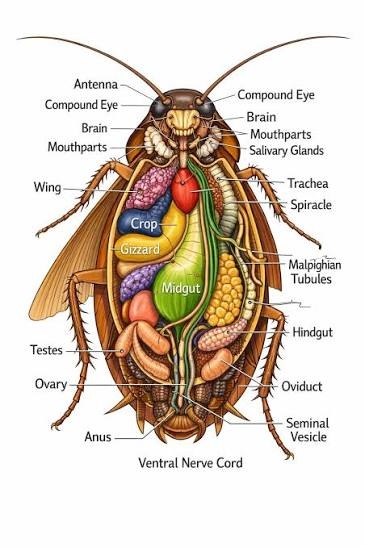
The curriculum explains key systems, including the digestive, respiratory, circulatory, nervous, reproductive, and endocrine systems, as well as external morphology and sensory structures.
Special emphasis is placed on linking anatomical and physiological traits to pest behavior, damage mechanisms, and identifying specific structural vulnerabilities—such as the tegument, digestive tract, respiratory system, reproductive organs, and endocrine system—that can be targeted in modern, integrated pest management strategies.
Learning Objectives Upon completion of this course, students will be able to:
-
Identify major morphological structures of the insect tegument and understand the physiological stages of molting, specifically regarding the penetration modes of insecticides and entomopathogens.
-
Analyze the insect digestive tract to relate feeding behaviors and dietary regimens to their specific anatomical and physiological adaptations.
-
Detail the reproductive systems of male and female insects, tracing the processes of gametogenesis, vitellogenesis, and fertilization.
-
Map the central and retro-cerebral nervous systems and understand their physiological roles.
-
Evaluate the endocrine system, specifically isolating the roles of cerebral, molting, and juvenile hormones in post-embryonic development.
-
Apply physiological principles to practical pest control, particularly utilizing third-generation insecticides like Juvenile Hormone Analogues (JHA) and phytoecdysones in agronomic applications.
-
Perform anatomical dissections and histological analyses of key organ systems to bridge theoretical knowledge with practical laboratory skills.
Course Details & Syllabus
Target Audience: 2nd Year, 2nd Cycle (Master) Plant Protection | Credits: 5 | Coefficient: 3
Chapter I: The Insect Tegument and the Molting Phenomenon
-
Morphology of the tegument and cuticle.
-
The different stages of molting.
-
Penetration of insecticides or entomopathogenic agents through the tegument and their modes of action.
Chapter II: The Digestive Tract, Diets, and Digestion
-
Relationship between different types of diets and feeding mechanisms.
-
Morphological and anatomical aspects of digestive tracts.
-
Physiology of digestion based on major dietary types.
Chapter III: Tracheal System and Respiration
-
The tracheal system in insects.
-
Physiological aspects of respiration.
Chapter IV: Reproductive Systems and Reproduction
-
Female Reproductive System: Anatomical specifics of the ovaries, ovarioles (and their structural types), oogenesis, differentiation of germ cells into oocytes and trophocytes, stages of vitellogenesis, and egg laying.
-
Male Reproductive System: Anatomy and function.
-
Fertilization: Different aspects of fertilization in insects.
Chapter V: The Nervous System
-
Central Nervous System: The protocerebrum, deutocerebrum, and tritocerebrum; the subesophageal ganglion mass; thoracic and abdominal ganglia.
-
Retro-cerebral Nervous System.
Chapter VI: Endocrinology: Experimental Hormone Demonstration
-
Demonstration of the Brain Hormone (BH).
-
Demonstration of an intermediate mechanism in the prothoracic gland.
-
Demonstration of the Juvenile Hormone (JH).
-
The intervention of Molting Hormone and JH during post-embryonic development.
Chapter VII: Third-Generation Insecticides
-
Properties of Juvenile Hormone (JH).
-
Synthetic and natural homologues of JH (e.g., Juvabione).
-
Isolation of Juvabione and synthetic JH.
-
Properties of Molting Hormone and Phytoecdysones.
Chapter VIII: Practical Application of JH Analogues in Pest Control
-
Conducting efficacy tests and principles of control.
-
Physiological consequences of JHA application.
-
Examples of agronomic applications for JHAs.
Practical Work (Laboratory)
-
Anatomical Dissection: Dissection of an insect to identify various organs, with a specific focus on the central and retro-cerebral nervous systems, corpora cardiaca, and corpora allata.
-
Histology: Examination of histological sections of the stomodeum, mesenteron, and proctodeum.
-
Respirometry: Quantification of oxygen consumed by an insect.
Assessment Method
-
Mid-term examination (Examen de moyenne durée).
- Enseignant: Randa Mlik